Given the functional importance of grinding applications , developments in this area can dramatically impact both product quality and production economics.
Coil springs are integral components in a wide range of applications, from automotive suspensions and industrial machinery to medical devices. As the demand for precision-engineered springs with high fatigue life increases, so does the pressure on manufacturers to optimise production processes.
Grinding, which refers to the removal of material from the spring ends to ensure flatness and parallelism, is one of the critical steps in coil spring manufacturing. Traditionally, this was a very labour-intensive and time-consuming operation. However, with recent technological advancements, efficiency has been significantly improved enabling higher throughput and better quality control.
End grinding operations on coil springs helps to ensure stable seating which prevents the springs from tilting under load, and accurate lengths, creating uniformity in batch production. When ends are properly ground, stress concentrations are reduced and spring-life is enhanced.

Spring end grinding applications can be done on either vertical, or horizontal spindle machines with either double head or single end grinders. Horizontal spindle machines can facilitate both single and double end grinding, while vertical spindle machines are only for single-end grinding applications. Double-head grinders are typically used for grinding smaller springs where both ends of the springs are ground simultaneously, in comparison to single-end grinders that only grind one end of a spring at a time, more suited to bigger springs, like those used in the railway and automotive sector, that would be to be too large to go through the gap of the double head grinders.
For applications using the double head grinding system, springs are loaded onto a rotating table with bushings to hold them in place. They are then fed in between the two wheels resulting in both ends being ground. As this application is mostly done without coolant, it is key to select a grinding wheel with the correct specifications to deliver both a cool grinding application, and perform the correct stock removal rate required within the minimum amount of passes.
On single end grinders, the grinding wheel is mounted on the horizontal spindle whereafter the springs are clamped into a fixture that is rotated at the face of the grinding wheel. As there is a bigger area of contact, these machines need to be used with coolant.
During the spring grinding application, it is crucial that springs are fed across the entire face of the grinding wheel. In the case where a grinding wheel has a centre bore; a spring should break into the centre by around a quarter of the springs’ diameter.
If the springs do not pass through the entire face of the grinding wheel, it could potentially lead to a wheel not breaking away evenly, possibly leaving a high spot that would frequently need to be dressed away which could result in the wheel being dressed away prematurely. On the other hand, if this high spot is not dressed, it could cause issues with spring squareness.
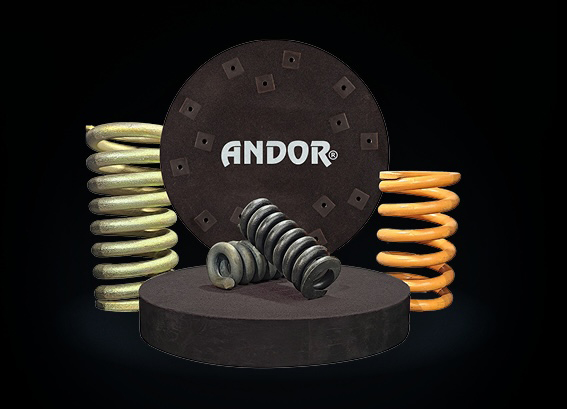
Lug mounted precision grinding wheels for spring grinding have nut inserts that are built into the hard fine back of the grinding wheel, which is then fastened with bolts securing the grinding wheel to a back plate. The other type, being tapered on the sides, are fitted onto a back plate with either a ring, or clamps that are tightened against the wheels tapered to the back plate.
Depending on the type of material and diameter used, aluminium oxide, ranging from tough to semi friable, to friable is the most common grain used in the manufacturing of spring grinding wheels. In certain instances where a very fine wire is used, white aluminium oxide could be a better choice as it is the most friable grain – staying sharper for longer.
To cut down on grinding time and keep the springs cool, sintered aluminium oxide is increasingly becoming more and more popular. This type of grain stays sharper for longer and as it breaks down, it breaks down in much smaller fragments compared to the other types of Aluminium oxide. Although this is a much more expensive type of grain to be selected, the cut back on faster throughput and wheel life make it a lot more cost effective in the long run.
For further information contact Grinding Techniques on TEL: 011 271 6400 or email info@grindtech.com or visit www.grindtech.com

