The Production Technologies Association of South Africa (PtSA) recently commissioned Professor Justin Barnes and his team from African Industrialisation Services to provide the PtSA with a clear strategic review of the South African tool, fixture, die and mould (TDM) manufacturing sector. The goal of the study was also to give a comprehensive set of recommendations to support the future development of the sector in South Africa.
Opening the Western Cape event, held at the Durbanville Country Club in late August, and noting the significance of tooling in manufacturing, Bob Williamson, PtSA National Secretary said: “Tooling occupies a key position in the industrial supply chain linking product development and production. 60% of manufacturing efficiency – meaning the cost that a product is sold for ¬– is directly linked to the tooling selected for the manufacturing process.”
Williamson continued: “Outsourcing the manufacturing of your tooling, especially to competitor countries, has a direct impact on the efficiencies of your manufacturing capabilities because you disclose the intellectual property you have over your product and your manufacturing processes to them. Toolmakers, therefore, occupy a critical position of trust.”
Prof Barnes’ report, titled Moulding a Better Future, was commissioned by the PtSA to paint a comparative picture of a similar study undertaken in 2005. The latest report, done by Barnes and his team, didn’t render much positive news for the current state of affairs in the local TDM sector.
“There are pockets of excellence and these are to be celebrated, but on aggregate, the overall progression of the sector is in decline,” noted Barnes. He explained that this is in direct correlation to the South African manufacturing sector as a whole, an industry that relies heavily on the often-unspoken protagonist of manufacturing – tooling.
“While there is a lot of noise about disruptive digital technologies, the mechanical processes [involved] remain critical to manufacturing,” said Barnes.
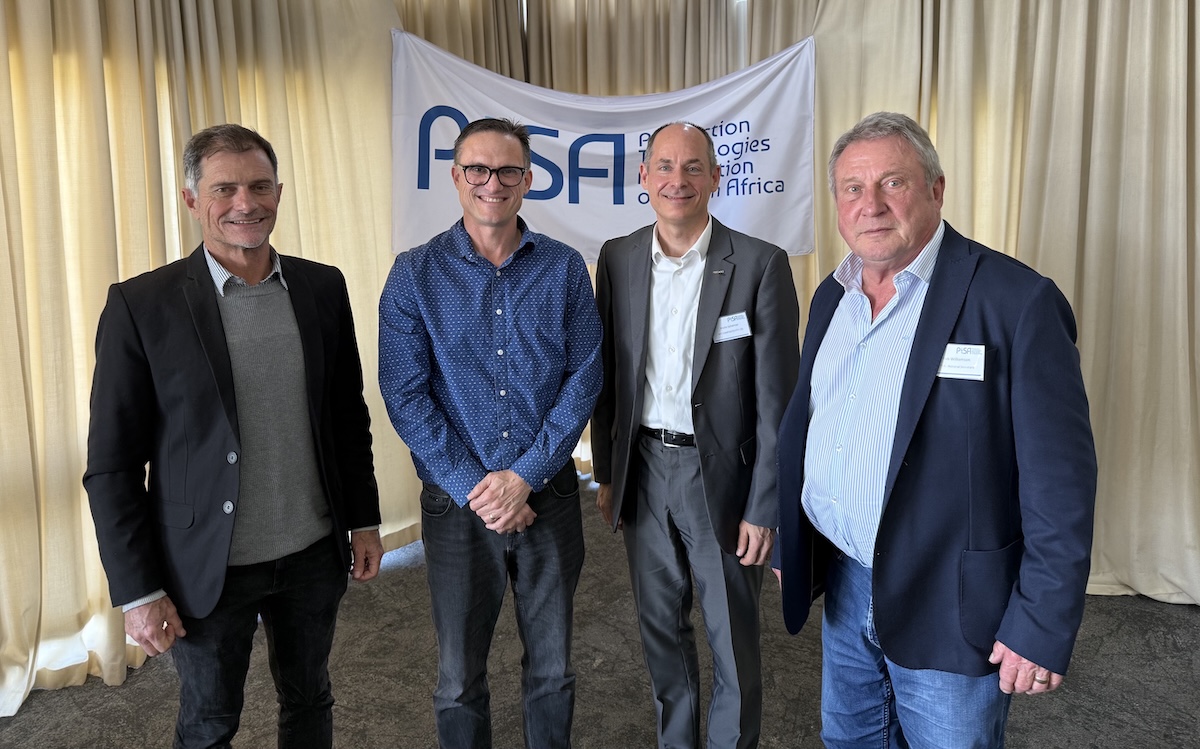
Members of the panel discussion that was held at the PtSA Western Cape breakfast workshop that took place in August 2025 on the strategic review of the South African tooling industry. From left to right, John Lawson, CEO Cape Chamber of Commerce and Industry, Malte Scherner of AAT Composites (Pty) Ltd and PtSA Regional Chair Western Cape, Professor Justin Barnes of African Industrialisation Studies and Bob Williamson, PtSA National Secretary
According to Barnes’ study, many major weaknesses were identified in the interviews conducted during the study, suggesting major negative developments since 2005. These included expensive, unreliable energy, very limited large TDM capabilities, aging equipment and capital base erosion, no consistent and stable baseload of work, global competition at extremely low prices, dependence on imported materials that are often expensive, local transport/logistics costs, limited master TDM skills and design and project management skills issues.
The study’s findings also highlighted that, “A few of the major threats identified in 2005 appear to have been realised, with their pressure continuing to shape the outlook for the South African TDM sector. New threats relate to South African political and economic stability, insufficient government support for the TDM sector, and the loss of master skills.”
Other influencing factors included the growing dominance of China, [the] automotive industry’s increasing technical and digital demands, technology shifts/access to technology and the loss of master skills ([due to] retirement and emigration).
“The threats posed by China and India’s emergence as new global competitors, as identified in 2005, appear to have been realised (again, also evident in South Africa’s trade data), as has the growing complexity of each new generation of automotive technology.”
Skilled labour retention will continue to remain a challenge as well as will the ongoing difficulties associated with attracting youth into the manufacturing industry. The transfer of skills is desperately needed for the modularisation of skillsets that will be required as technologies change and companies will need to learn how to develop products as efficiently as possible.
Barnes’ report suggested the solutions offered to the problems drew heavily on the experience from the successful Portuguese TDM industry. Professor Jose Ferro Camacho, an international TDM expert, provided the following guidance for the development of the South African sector:
• To encourage learning between firms through informal knowledge sharing and benchmarking. To engage with TDM technology centres via demonstration projects, using new technologies, offering shared access to equipment for SMEs. To implement training, workshops and pilots on new technologies and for an intermediary to exist between research institutions, service providers and firms.
• There is a need for collaboration with universities that includes joint research and innovation projects and Masters and PhD research. Further to this, TDM community clusters need to exist and consortium-based innovation projects along with information dissemination events will help, as will the development of technology roadmaps.
• The transfer of technologies from key suppliers via methods like on-site training and demonstrations and encouraging lead-users in clusters and lead-firms to diffuse their knowledge are paramount. Establishing advanced standards, offering technical support and securing support from the public sector will also be needed.
• Further, incentives like offering voucher schemes, digital transition grants and incentives for upgrading as well as deepening vocational training and skills upgrading coupled with offering modular courses – at firms where appropriate – with key focus areas on: CNC programming, CAD/CAM, 3D printing, automation, sustainability and energy efficiency.
Industry also needs to demonstrate its upgrading to the broader community and show success stories as these are powerful change motivators – something Metalworking News magazine has been doing in the manufacturing industry for more than 25 years.
During his presentation, Prof Barnes made no hesitations mirroring his thoughts and dismay at the state of South Africa’s automotive manufacturing industry, one that relies heavily on the tool and die industry. He called out the media in general for painting such a rosy picture of the industry when in actual fact, despite the billions of rands that have been ploughed into the industry by the big OEM automotive manufacturers – which is to be applauded – local industry is in decline.
The industry, he says, is under enormous stress and pressure from the wide availability of cheaper imported vehicles and the general state of the local economy and its middle class whose purchasing power has significantly eroded in recent years.
Referring specifically to Mercedes-Benz South Africa and its chances of survival, he said: “The numbers just don’t add up for me.”
Legislative changes such as the scrapping of the ad valorem tax, essentially a luxury excise tax that exponentially increases with the price of a vehicle, and continued investor encouragement are critical to the local sector’s survival if it is to compete against the flood of much cheaper imports.
A statement released recently by naamsa reflecting on recent automotive sales data says: “Vehicle exports to the US – South Africa’s second-largest trading partner and historically a key destination for domestically manufactured premium models – have plummeted by 82.2% in the first half of the year compared to the first half 2024, dealing a significant blow to production volumes and supplier networks.”
Said naamsa CEO Mikel Mabasa on the implementation of US tariffs: “The reimposition of these tariffs is deeply disappointing and has far-reaching implications. Without urgent trade remedy, the socio-economic fallout could be severe.”
Continued the naamsa statement: “The year 2025 marks a critical juncture for South Africa’s automotive industry as it prepares for the review of the South African Automotive Masterplan 2035 [SAAM35] and the Automotive Production and Development Programme Phase 2 [APDP2]. These reviews are intended to align the sector’s policy framework with shifting global market dynamics and to reset performance goals in light of both domestic and export challenges.”
Despite this, recent data is positive: “The South African new vehicle market continued its winning streak, with July [2025] delivering the highest monthly total sales figure reported since October 2019. Aggregate new vehicle sales increased to 51 383 units in July 2025, up 6 931 units, or 15.6%, from the 44 452 units sold in July 2024. This strength has been driven by improving consumer confidence, favourable credit conditions, and a steady recovery in disposable incomes. The July 2025 new passenger car market at 36 248 units, the highest monthly passenger car sales performance since January 2017, had registered an increase of 6 072 cars, or a gain of 20.1%, compared to the 30 176 new cars sold in July 2024.”
naamsa’s statement didn’t reveal how many of the new vehicle sales were of imported vehicles.
The automotive industry contributes 5.2% to GDP [3.2% manufacturing and 2.01% retail]. In 2024, the export of vehicles and automotive components reached a record amount of R268.8 billion, equating to 14.7% of South Africa’s total exports. The industry accounts for 22.6% of the country’s manufacturing output and vehicles and components are exported to 155 international markets
A question-and-answer session following Barnes’ presentation reflected the undertone of ‘many questions, no answers’, and speaking anecdotally, one attendee revealed on how some years ago his business was made up of 90% TDM manufacturing and roughly 10% repair work, now that same business spends 90% of its time carrying out repair work and only 10% on TDM manufacturing.
While the regionally held and well attended events themselves carried both positive and negative energy as industry searches for answers, what’s clear is that there is a lot of work to be done if the sector is to recover, let alone survive.
Said Agetha Westphal, PtSA Western Cape Industry Development Manager: “The PtSA roadshows have been an important platform to reflect honestly on industry challenges while also highlighting the opportunities ahead.”
“The comparison between 2005 and 2025 clearly showed how companies need to adapt, pivot where necessary, and align to remain competitive. A strong focus was placed on the automotive sector, yet there is still significant scope for Tool, Die and Mouldmaking (TDM) across the marine, defence, aerospace, FMCG, medical, and pharmaceutical industries.”
“The PtSA itself is taking a proactive step with the establishment of its first Centre of Excellence in Cape Town, near the Sanlam Centre. This facility will include an R&D hub to support industry with product development, skills readiness, and benchmarking – working alongside, not in competition with, the sector,” Westphal concluded.
The Production Technologies Association of South Africa (PtSA) is a non-profit membership organisation founded in 2006. Its mission is to promote, protect, and support the Tool, Die, Mould, and Special Machining (TDM) industry in South Africa to grow and develop the national manufacturing sector.
To date, the PtSA has trained over 1 000 toolmakers whose quality is on a par if not better than international standards with the top 10% of those toolmakers being black females, demonstrating real change in the industry.
For more information contact the PtSA on TEL: +27 12 760 0300 or visit https://www.ptsa.co.za
