South Africa’s manufacturing sector has seen many engineering businesses come and go over the years. Few, however, have remained focused on a specialised discipline while continuing to expand their capabilities and customer base. One such company is Mesh Gear, which this year is celebrating 50 years in business.
Established in Durban, KwaZulu-Natal in May 1976 by Michael Clayton and his wife Heather, Mesh Gear began as a small operation with three machines and two operators. What started as a modest gear-cutting business has developed into one of South Africa’s few dedicated gear manufacturing and precision machining facilities, supplying customers in industries that include mining, construction, agriculture, rail and industrial power transmission.
Today, the company operates from a 4 500m² facility where the complete manufacturing process is controlled under one roof. This approach has become one of the defining characteristics of the business. Rather than relying extensively on subcontracted operations, Mesh Gear has invested in the equipment, facilities and skills required to manage production from raw material preparation through machining, heat treatment, metallurgical verification and final gear grinding.
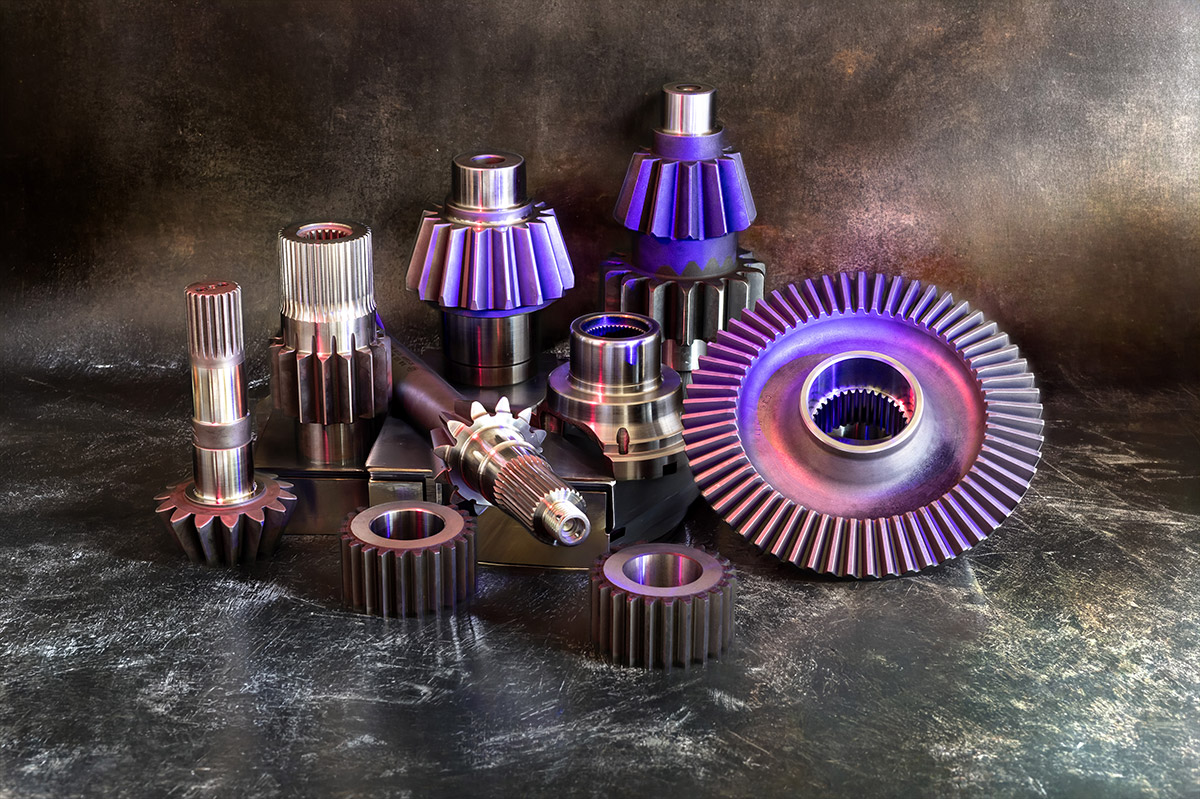
Mesh Gear manufactures a broad range of products including spur gears, helical gears, straight and spiral bevel gears, worm gears, sprockets, spline shafts, drive shafts, torque shafts, couplings, yokes and specialised components used in drilling, crushing and screening equipment. Image courtesy of Mesh Gear
The company manufactures a broad range of products including spur gears, helical gears, straight and spiral bevel gears, worm gears, sprockets, spline shafts, drive shafts, torque shafts, couplings, yokes and specialised components used in drilling, crushing and screening equipment. Its customer base includes both OEM manufacturers and aftermarket users requiring components for heavy-duty applications.
One of the factors that has distinguished Mesh Gear throughout its history has been its focus on production gear manufacturing. While many machine shops manufacture gears as part of a wider engineering offering, Mesh Gear has concentrated on developing dedicated gear manufacturing expertise and equipment. Its capabilities include external and internal gear cutting, spline manufacturing, thread and worm milling, bevel gear production and high-precision gear grinding.
The company can manufacture gears of up to 1 000mm in diameter, serving both low-volume specialised projects as well as larger production requirements.
Over the years, investment in technology has remained a priority. The company has regularly expanded its CNC turning and machining capabilities with advanced 5-axis machining technology to improve efficiency and accuracy in the manufacture of complex gear components.

Mesh Gear have put in place new heat treatment laboratory equipment that allows them to be able to view the microstructure of the gears more accurately via a computerised system. This allows for better metallurgical analysis after heat treatment, and better data storage of gear batches. Image courtesy of Mesh Gear
The addition of 5-axis machining has been particularly important in the production of spiral and straight bevel gears, where machining accuracy directly influences gear performance and interchangeability.
“We now have four DMG Mori 5-axis DMU monoBLOCK machining centers. These universal machining centers with a swivel rotary table are ideal for small-to-medium production runs,” says Steven Clayton, director at Mesh Gear.
Gear grinding is also a key area of focus for Mesh Gear. As customer requirements have evolved and tolerances have become more demanding, Mesh Gear has invested in CNC gear grinding technology capable of producing gears for applications where precision and reliability are critical.
“We have also invested in two KAPP NILES CNC gear grinders. These are a ZE 800 – a high-precision, CNC-controlled gear profile grinding machine. It is primarily designed for the precise gear grinding of both internal and external gears and enables us to be able to grind larger gears,” continued Clayton.
“The second one is a KAPP NILES ZE 400. Both of these gear grinders are able to measure the gear tooth profile on the machine.”
“We have also put in place a brand new KAPP NILES KNM 5X gear testing machine, as many of customers prefer us to measure the gear profile and pitching errors off the gear grinding machines.”
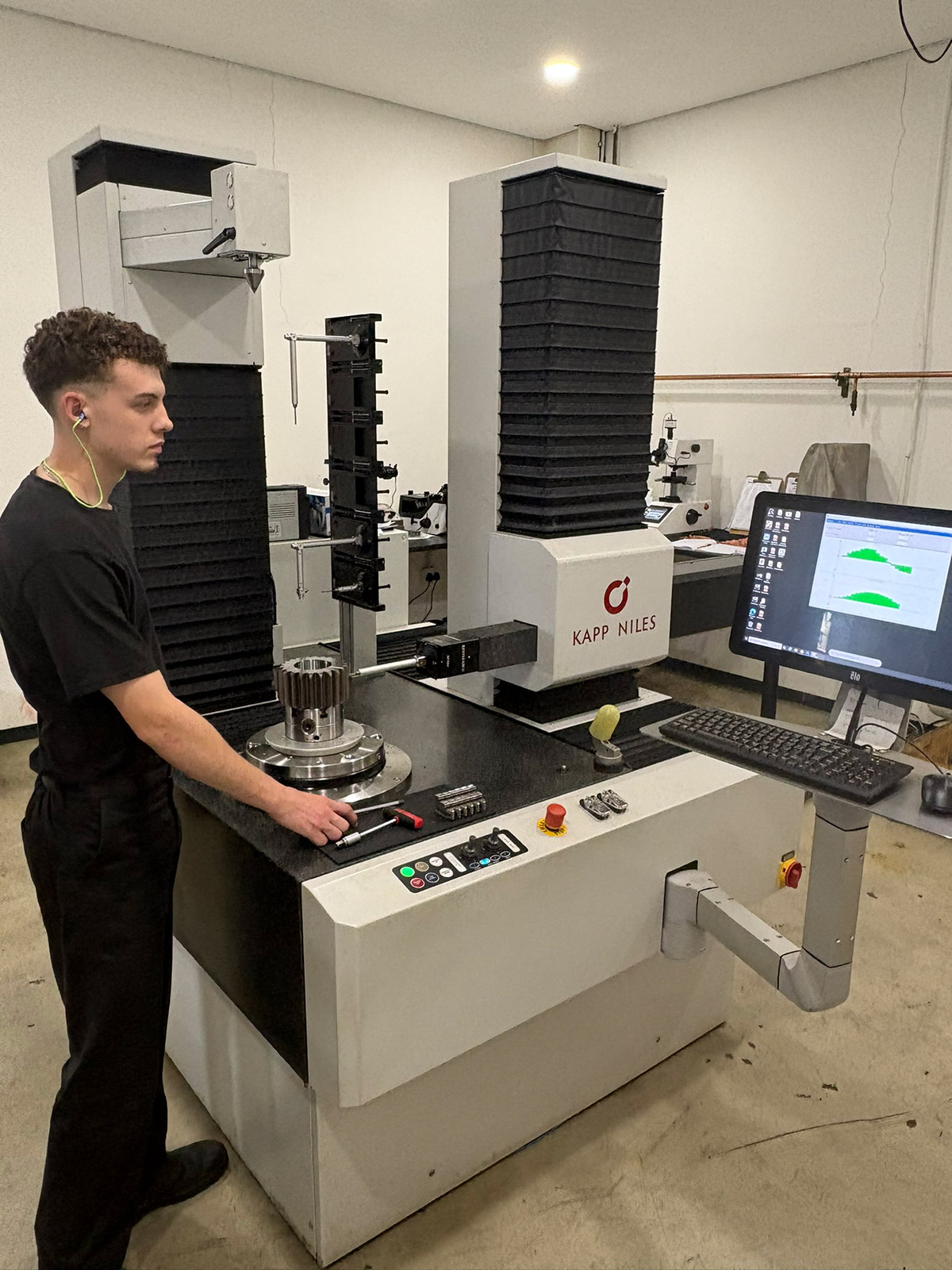
Mesh Gear have invested in a new KAPP NILES KNM 5X gear testing machine, as many customers prefer to measure the gear profile and pitching errors off the gear grinding machines. Image courtesy of Mesh Gear
“Currently we are waiting on the arrival of a retrofitted CNC gear shaper from the US that is on the water at the moment. It’s a Fellows 10-6 four-axis CNC gear shaper with a Fanuc OI-MF plus control that’s got a larger horse power spindle motor and 7” throated riser. It has a 6” stroke.”
In-house heat treatment
Heat treatment represents another area where Mesh Gear has adopted a different approach from many manufacturers. Recognising the influence of heat treatment on gear performance, the company established comprehensive in-house facilities that include gas carburising, gas nitriding, induction hardening, normalising, conditioning and associated metallurgical testing. “We have upgraded our heat treatment controls, so that multistage load cycles can be set in advance. The heat treatment controls are also able to be viewed and manipulated remotely.”
Maintaining control over these processes allows tighter management of distortion, hardness and material properties, factors that directly affect gear life and performance.
“There are only two gear manufacturing companies in South Africa that have their own heat treatment facilities and this is a big plus for our business and it also provides peace of mind for our customers,” explains Clayton.
Supporting these operations is an in-house metallurgical laboratory where material properties and heat treatment results can be verified before components are released to customers.
“We have put in place new heat treatment laboratory equipment that allows us to be able to view the microstructure of the gears more accurately via a computerised system. This allows for better metallurgical analysis after heat treatment, and better data storage of gear batches.”
“This additional laboratory equipment includes a Time Micro Vickers tester for analysing the case depth, core hardness and case hardness. As well as a Nikon Eclipse MA100N microscope for analysing the microstructure under 500x magnification, ensuring there is no presence of unwanted defects from the heat treatment process such as carbides, retained austenite or granular oxidation. The microstructure and potential defects are then measured using related software and the images stored electronically and supplied to the customer if requested.”
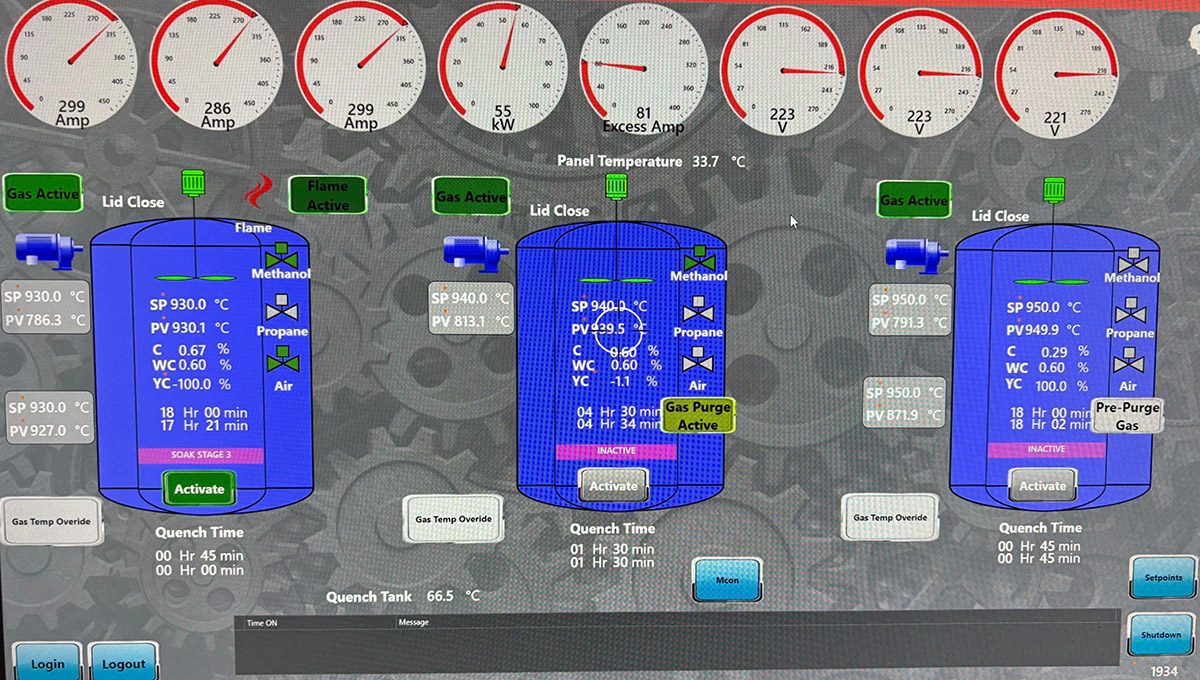
An image of Mesh Gear’s furnace control system. Image courtesy of Mesh Gear
“Additionally, we have invested in an induction hardening machine for the hardening of drive shafts, yokes, flanges and pins. This induction hardening machine is CNC controlled, is low frequency and can achieve case depths from 1mm to 12mm. The machine can handle shafts / pins of up to 2 metres long and 200mm in diameter, as well as smaller items such as yokes and flanges.”
This integrated manufacturing model aligns with the company’s long-standing emphasis on quality assurance and process control. Mesh Gear also maintains an ISO 9001 quality management system that has been in place for more than two decades.
The company’s growth has been accompanied by continuity in leadership and today, Mesh Gear is managed by Michael Clayton’s sons, Steven and Trevor Clayton, representing the second generation of family ownership.
Having grown up within the business, both have played a role in expanding the company’s technical capabilities while maintaining the manufacturing principles established by their father. The result is a business that combines long-term industry knowledge with continued investment in modern manufacturing technologies.
Their experience has provided a foundation in gear design, metallurgy, machining and quality control that has shaped the direction of Mesh Gear. For the company, the anniversary reflects not only longevity but also a sustained commitment to technical capability, process control and investment in production technology that will provide continuity into the coming decades producing gears and transmission components capable of meeting the demands of heavy industry.
Mesh Gear now employs 100 staff and runs its operations over two shifts, with over 100 machines across the shop floor.
For further information contact Mesh Gear on TEL: +27 31 461 1121 or Trevor Clayton Cell: +27 82 304 5781 or email: trevor@meshgear.co.za or visit https://www.meshgear.co.za
