In the lead-up to EMO Hannover 2025, the world’s largest trade fair for production technology, the VDW (German Machine Tool Builders’ Association) hosted its international press preview event on 10 – 11 July in Frankfurt am Main. The event gathered over 150 participants from 24 countries, including some 80 journalists from all over the world, to outline what will shape this year’s exhibition and to discuss the state of the global manufacturing sector.
This year marks 50 years of EMO and EMO Hannover’s 2025 Preview, held at the VDW (Verein Deutscher Werkzeugmaschinenfabrikenn – German Machine Tool Builders’ Association) headquarters provided a comprehensive look at the technologies and themes set to dominate the world’s largest metalworking trade fair this September.
Journalists from around the world attended to hear from organisers, exhibitors, researchers, and to visit TU Darmstadt’s ETA living lab Factory for an in-depth view of sustainable manufacturing practices ahead of the world’s leading exhibition for production technology, scheduled for September 22 – 26 in Hannover, Germany.

Journalists and EMO Hannover Preview exhibitors came together in Frankfurt am Main on 10 – 11 July to gain insights into manufacturing’s next phase. EMO 2025 is set to bring the metalworking community together from September 22 – 26 in Hannover, Germany
Opening the event, Dr Markus Heering, Executive Director of VDW, outlined the fair’s four central themes: automation, digitalisation, artificial intelligence and sustainability. “We are seeing a strong international response to EMO 2025,” said Heering. “Companies are preparing to use the event as a platform to drive the next phase of capital investment. The industry is looking for solutions that can deliver immediate value, and EMO is where they intend to find them.”
The Frankfurt preview made one point clear: EMO 2025 will present manufacturing technologies as part of complete, integrated solutions designed to “Innovate Manufacturing”. Automation will respond to workforce shortages, AI will strengthen productivity and decision-making, working alongside humans, and sustainability will continue to move from a talking point to a measurable operational strategy.
“The technologies on show in Hannover will not just reflect where the industry is, but where it’s going,” said Dr Heering. “That’s why EMO continues to matter.”
For visitors, the AI Hub, automation-focused exhibitors, Canada’s pavilion as the first official partner country and sustainability showcases will be key areas of focus. With the groundwork now laid in Frankfurt and the message firmly spread across the globe after the EMO Hannover World Tour, EMO Hannover 2025 promises to deliver a comprehensive view of the future of manufacturing – in practice, not just in theory.
Dr. Heering made clear of EMO’s global relevance: “Nowhere else can guests encounter so much international expertise as at EMO,” he said. There may be bigger exhibitions out there, but none cater quite to the international metalworking community quite like EMO does. He noted that despite economic uncertainty, anticipation remains high. “Positive signals are expected from EMO. Whether technical innovation or round-the-clock automation – both exhibitors and visitors arrive expecting to leave confident.”
This spoke to the undertones of current economic uncertainties around the world as well as the geopolitical tensions such as the ongoing wars. However, he emphasised that just as the world had overcome problems previously, so too would it overcome and grow again.
A milestone edition under complex global conditions
This year’s EMO marks the 50th anniversary of the biennial exhibition, a fact that Dr. Heering highlighted as both a cause for celebration and reflection. “Over the last 50 years we have seen a lot of changes in metalworking industries, and EMO was always the place where innovation first appeared,” said Heering. “This year, artificial intelligence is the highlight.”
The emphasis on AI reflects a broader push by the industry to address labour shortages, rising energy costs, and increasing demands for sustainability. Heering emphasised the role of the exhibition in providing direction during a period he repeatedly described as one of uncertainty.
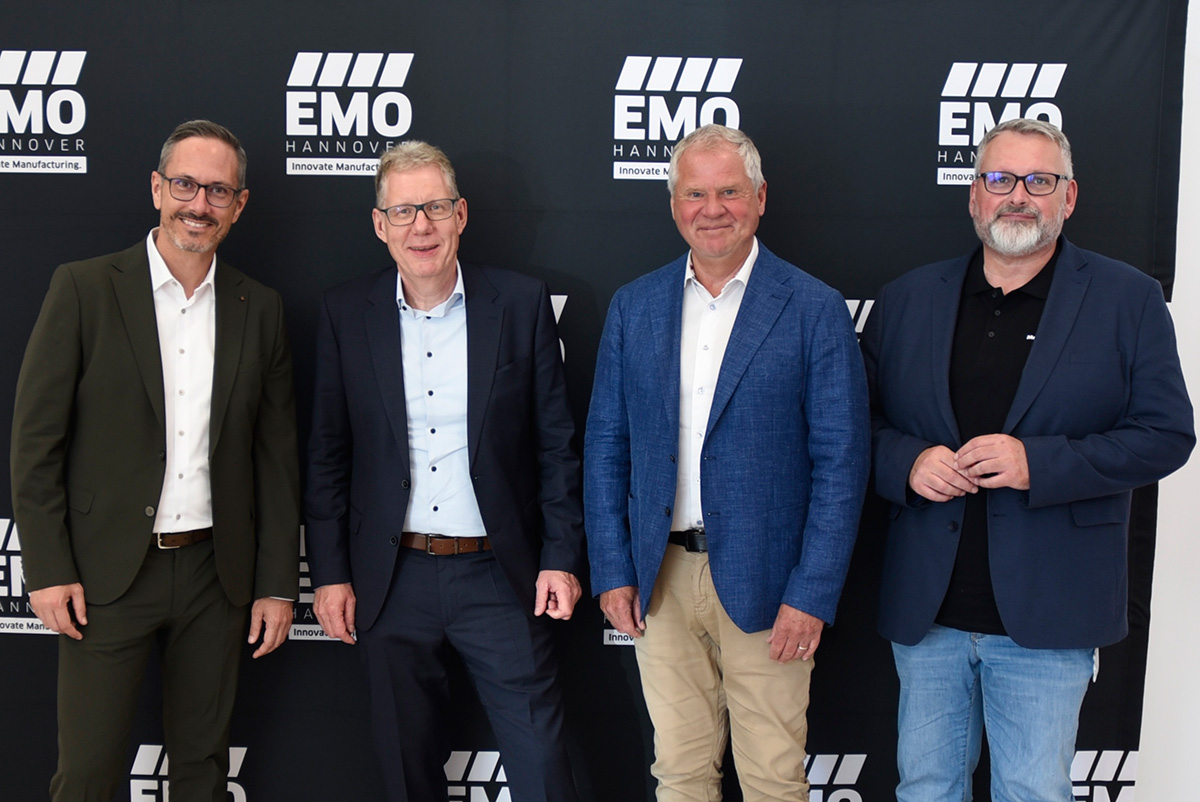
From left to right, EMO Preview 2025’s panel discussion moderator Sven Krause, himself having worked in the automotive manufacturing sector for many years, was the perfect fit for helping shape the discussion on manufacturing’s next phase. He is pictured with Dr Markus Heering, Executive Director of VDW, Jayson Myers, CEO of Next Generation Manufacturing Canada (NGen) and Martin Göbel, Director of Exhibitions at VDW
“What we see in the global market, especially in Germany and in Europe, is that we have multiple pressures, not just one reason. Covid is over, there will be a recovery. We had a financial crisis before, but there will be a recovery. Now we have geopolitical challenges – wars in the Middle East, in Europe, the competition between China and the United States, and a resurgence of nationalism and populism that is disrupting markets.”
“Skills shortages continue to be a pain point. People no longer want to work on the shop floor. The next generation is more likely to work on computers or ‘would like to be an influencer’,” he said. “Automation can help address labour shortages as well as improve the use of energy, resources and materials. Digitalisation has matured to where SMEs see the business case for connectivity. Both are critical to sustainability because resources, from raw materials to carbon-based fuels, are not endlessly available.”
Despite these challenges, Heering expressed cautious optimism: “I’m convinced that we see that recovery starts now, step by step, very slowly. Incoming orders are improving in some markets. EMO is at the right time and it could offer orientation.”
Previewing the themes of EMO Hannover 2025
The Frankfurt preview event offered a compact overview of what visitors can expect at the show in Hannover. Participating journalists attended presentations by 26 exhibitors, each given 90 seconds to pitch their key innovations. These included advances in process automation, machine tools and tooling, AI, robotics, quick-change systems, software, energy efficiencies and additive manufacturing.
The 90-second-long pitches were a refreshing approach for some of the largest industry players to get their in-house developments and points across. This also allowed plenty of time for journalists to network and discuss innovations with the manufacturers in a more personal manner in a condensed exhibition type format.
The list of exhibitors that took part in this first-of-its-kind and welcomed by all type event included 3nine, Anca, Chiron, Cimsource, Datron, DBinformation, DMG Mori, DN Solutions, Hainbuch, Heller, Hermle, HSD Mechatronics, Huron Graffenstein, Igus, MVK-line, Okuma, Renishaw, Schaeffler, Schunk, Siemens, Tebis, United Machining Solutions, Urma, Vigel, Waldrich Coburg and Zoller. Watch their pitches in the video below.
Not using AI is not an option
AI’s role in production was a focal point throughout the event – both in respect to the official programme as well as during informal discussions amongst international colleagues in attendance.
A panel discussion – “Perspectives on artificial intelligence in production: How will we surprise our customers in the next (five) years?” – hosted by Prof Michael Zäh, Chair of Machine Tools and Manufacturing Technology (TU Munich) with data/AI consultant Sebastian Heinz, founder and CEO of statworxs – made clear AI is no longer something to play around with. The panel framed AI’s short-term contribution in accelerating engineering cycles and enabling more robust process automation. Both speakers stressed the need to train organisations to recognise AI failure and to implement guidelines for anticipating and recognising these current shortfalls.
The session also previewed the AI Hub @EMO 2025, intended as a focal point for case studies and implementation guidance at the fair. Prof. Zäh delivered the realist’s view. “AI makes mistakes,” he said. “Recognising this is a skill we must train.” He was similarly categorical: “Not using AI is not an option. Others already are, and those who don’t will lose out.”
Canada as EMO’s first ever partner country
One of the significant features of the EMO Preview 2025 is Canada’s role as the event’s first ever official partner country. Jayson Myers, CEO of Next Generation Manufacturing Canada (NGen), used the Frankfurt preview to outline why Canadian industry is engaging with the event, and reaching out the rest of the world at the same time.
NGen connects approximately 11 000 members across Canada, including manufacturers, technology providers, universities, and research institutions. “We do have an unruly neighbour to the south, but I think that is probably providing Canadian companies with not only a lot of enthusiasm about finding new customers, finding new suppliers, finding new innovation partners, but also about transforming their businesses,” Myers said. “One surefire way of overcoming any problem around tariffs is to become super-efficient. That drives productivity and positions manufacturers as stronger partners.”
Myers noted Canada’s growing emphasis on AI-enabled manufacturing as an example of how to remain competitive in global markets. “Machine learning is an AI technology, but it also assumes that there’s a machine involved, sensors, data collection, and connectivity to bring it together. Discussions about AI without considering the supporting technologies are only part of the picture. The actual value is in integrating technology to solve real industrial problems. That’s what we do at NGen. We’ve invested about $215 million in projects over the past three years, and the return on that investment so far is 42 times that in terms of sales and IP licensing,” he said.
If ever countries were looking at new markets and new opportunities, now is probably a good time to get in touch with Canada.
Technical University of Darmstadt’s ETA living lab Factory tour
A tour of the ETA research factory at the Technical University of Darmstadt on the second day of the EMO Preview provided a practical look at developments aimed at achieving climate-neutral production. The facility’s projects illustrated how digitalisation, energy-efficient processes, and integrated production systems can contribute to sustainability goals – themes set to feature prominently in Hannover.
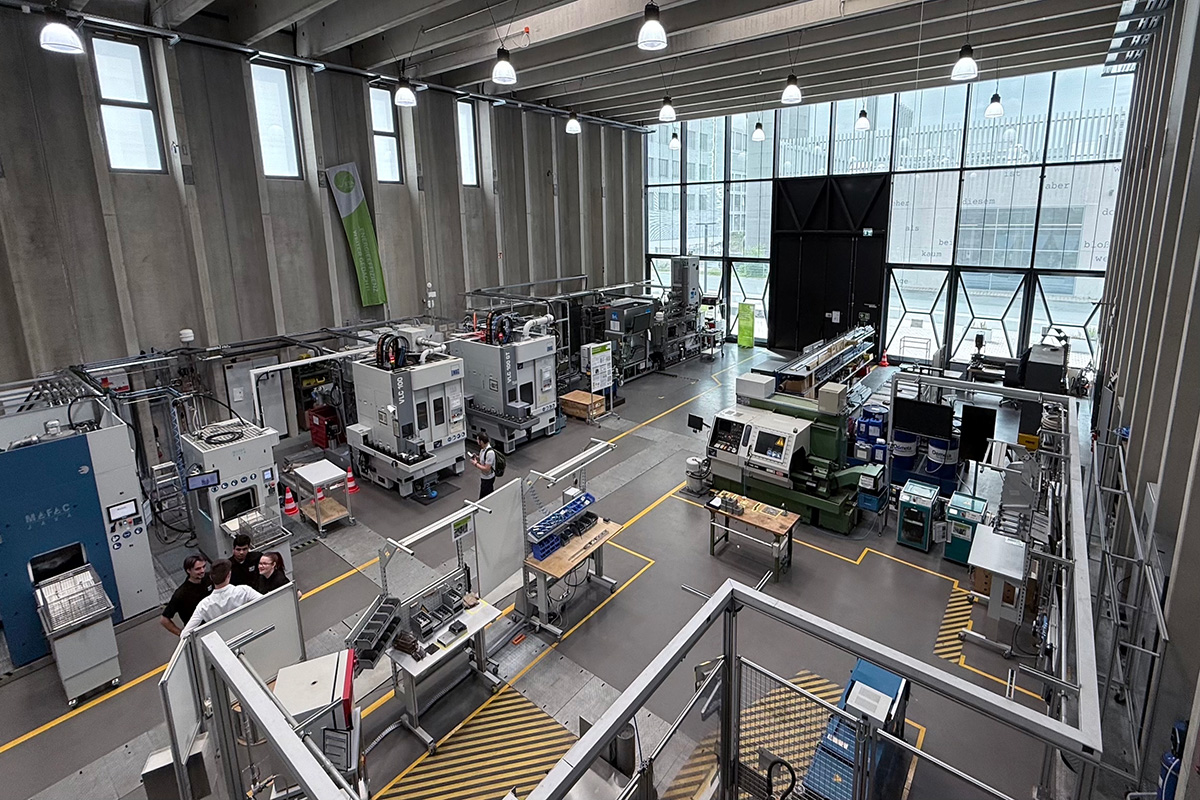
International journalists were given a comprehensive tour of Technical University of Darmstadt’s (TU Darmstadt) ETA living lab Factory. The tour provided insights into what smarter manufacturing can and should look like. It’s debatable if the world will ever achieve such a target, but at least the manufacturing industry is trying
The ETA Factory, situated on the Lichtwiese campus of the Technical University of Darmstadt, operates as a “living lab” for energy-efficient manufacturing. Established in 2016 through publicly funded projects, the facility provides infrastructure for ongoing research into production processes and energy technologies. The Institute for Production Management, Technologies and Machine Tools (PTW) coordinates much of the activity, with investigations centred on flexibility in manufacturing, waste heat recovery, and the contribution of industrial plants to grid stability.
The site incorporates a hybrid storage system and an intelligent charging station developed by the Institute of Mechatronic Systems. The hybrid storage not only stabilises the factory’s power supply but also enables testing of operating strategies using real-time and forecast energy data with the ability to predict optimal shop floor production capacity based on such elements as weather prediction models.
The factory can temporarily self-supply the plant in island mode when required. The charging station, designed for integrated communication with industrial infrastructure, allows continuous control of charging power. This enables studies on optimising strategies that address grid quality, energy procurement, battery ageing, and cost efficiency. All in real-time.
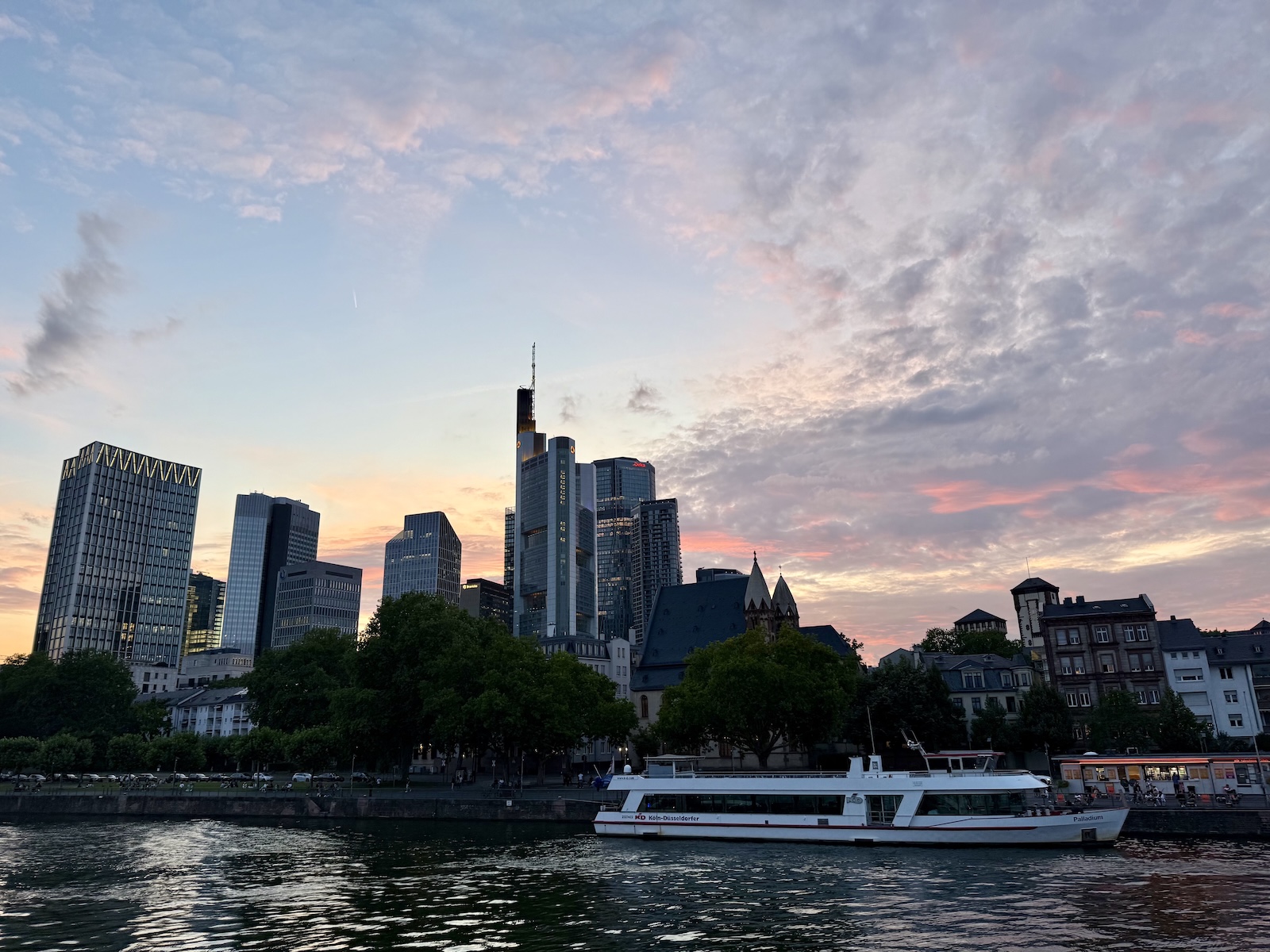
Journalists and EMO Preview’s participating exhibitors enjoyed a boat cruise along the river Main where informal networking and industry reflection took place. Frankfurt’s summer evening skyline provided a perfect backdrop to an evening enjoyed by all
EMO’s international reach
Heering concluded the preview by stressing EMO’s global role. “EMO positions itself as the most important platform for dialogue between international players in the industry. EMO has always been about global exchange.”
EMO Hannover 2025 will present a forward-looking agenda shaped by the pressures and opportunities of today’s manufacturing environment – a combination of technological progress, economic caution, and international collaboration. This will continue to reinforce EMO’s position as the meeting point for the world’s machine tool industry.
Thank you to the VDW for hosting a memorable and insightful event.
For further information visit: https://emo-hannover.com

