Wagner Systems’ recent investment in a FANUC Robodrill α-D21SiB5 ADV Plus marks an important step in expanding its high-speed milling capability for the production of micro, complex fine-mechanics components.
For the company, the commissioning of this new acquisition is about more than adding another CNC machine to its production floor. It represents an important step in expanding the Cape Town company’s milling capability and building on more than 50 years of experience in the production of fine mechanics components and assemblies.
There is also a distinctly South African angle to the investment. According to FANUC South Africa, Wagner Systems is currently the only customer in South Africa operating a SHORT ROBODRILL.
For a company whose manufacturing capability has traditionally been weighted towards turning, the new machine opens the door to a broader range of milling applications while being specifically configured around the fine mechanics work for which Wagner Systems is known.

Wagner Systems’ FANUC Short Robodrill α-D21SiB5 ADV Plus with operator at the control providing an indication of the compact size of machine
A machine selected for fine mechanics
The FANUC Robodrill α-D21SiB5 ADV Plus is a compact vertical machining centre with a relatively small footprint, designed for high-speed milling, drilling and tapping.
FANUC South Africa describes the Robodrill α-D21SiB5 ADV Plus as a super-compact machining centre capable of machining accurate parts using a high-power, high-speed spindle capable of reaching speeds of 24 000rpm. The Robodrill uses double-contact (BBT30) spindle taper tooling for additional rigidity and precision. Its Direct Drive Rotary unit (DDRiB) also enables simultaneous four-axis, high-volume machining.
For Wagner Systems, these capabilities are particularly relevant to the production of fine mechanics components, where small-diameter cutting tools, outstanding surface finish and dimensional consistency are important considerations.
The machine has a 630mm x 330mm table, XYZ travels of 300mm, 300mm (+100) and 400mm respectively, and a maximum table load of 200 kg. It can accommodate 21 tools, with rapid traverse of up to 54m/min. FANUC specifies positioning repeatability of less than 0.004mm.
The ROBODRILL has therefore not been selected simply as a general-purpose milling centre. Its configuration reflects the particular requirements of Wagner Systems’ fine mechanics production, where components can be small and intricate, and where dimensional accuracy, surface finish and repeatability are critical.
For Wagner Systems, the significance lies not in any one specification, but in the way these capabilities have been combined in a machine suited to the type and size of components the company produces.
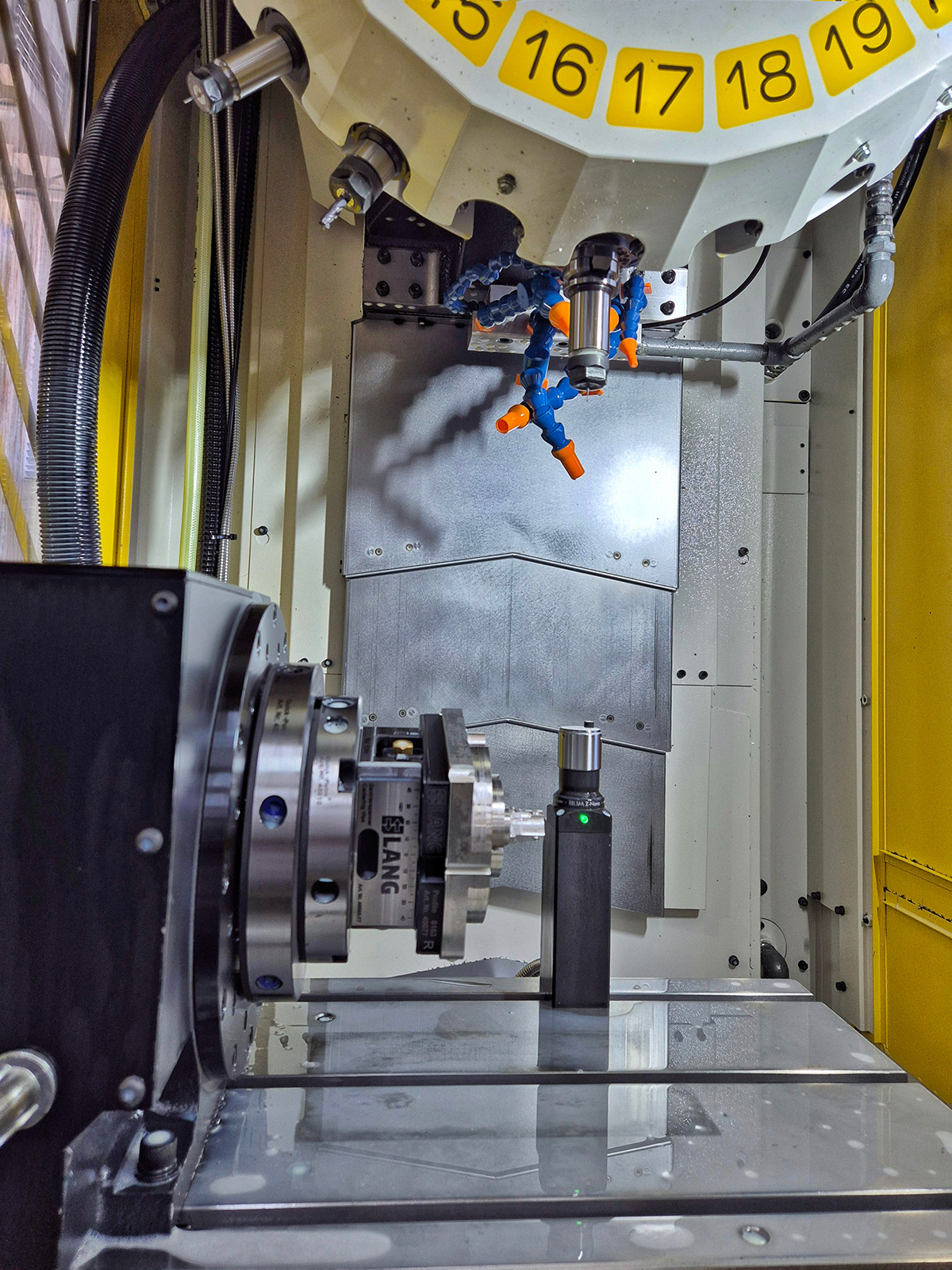
Inside the ROBODRILL, showing the machine’s fourth-axis DDRiB rotary unit, LANG Technik workholding system and BLUM Z-Nano tool-length measuring switch
High speed for small-diameter cutting tools
The machine has been fitted with the high-speed spindle option, capable of running at up to 24 000 rpm. This is particularly relevant to Wagner Systems because the company will initially use the Robodrill primarily for the production of medical device components, many of which require the use of small-diameter cutting tools.
High spindle speed allows small tools to achieve the cutting speeds required for efficient machining without relying on excessive feed rates. It also supports the production of good surface finishes on small components – an important consideration in fine mechanics manufacture.
Rigidity matters when the tools get small
But high-speed machining with small tools also brings another requirement – rigidity.
When cutting tools become very small, even relatively minor vibration or deflection can influence the machining result. Wagner Systems therefore specified the machine with BBT30 double-contact spindle tooling.
Unlike a conventional taper connection that relies primarily on contact within the spindle taper, the double-contact arrangement provides an additional contact between the toolholder flange and the spindle face. The result is a more rigid tool-spindle connection, helping to minimise movement and vibration during machining.
FANUC lists BBT30 as an available spindle-holder configuration for the α-D21SiB5 ADV Plus.
For Wagner Systems, this combination of a high-speed spindle and rigid toolholding is particularly well matched to the demands of small-diameter cutting tools and the surface finish and dimensional consistency required for fine mechanics components.
Adding a fourth axis
Another important part of the machine’s configuration is FANUC’s DDRiB direct-drive fourth axis.
The DDRiB is a compact rotary unit designed specifically for the Robodrill. Its direct-drive servo motor provides fast and accurate rotary positioning and, in Wagner Systems’ configuration, enables simultaneous fourth-axis machining. FANUC describes the DDRiB as a high-speed, high-accuracy fourth axis that occupies very little space on the Robodrill table.
Wagner Systems selected the DDRiB because it was considered particularly suitable for the type and size of components the company produces.

The ROBODRILL is set for machining a small fine-mechanics component, illustrating its application to the production of fine mechanics components using small-diameter cutting tools
The practical benefit of a fourth axis is that the workpiece can be rotated under CNC control as part of the machining process. For small and complex fine mechanics components, this can translate into fewer setups, greater consistency and the ability to produce intricate geometries more efficiently and with greater flexibility.
A 100mm raised block has also been incorporated into Wagner Systems’ machine configuration to accommodate the fourth-axis machining arrangement.
A move into milling
Perhaps the most significant aspect of the investment from Wagner Systems’ perspective is not a particular specification of the Robodrill, but what the machine represents for the company.
Wagner Systems has traditionally had a strong turn-part capability. The acquisition of the Robodrill is an initial investment in further developing its milling know-how and capability.
This is an important distinction. The company is not simply replacing an existing milling machine with a newer one; it is deliberately building a new area of manufacturing capability around a machine selected for the requirements of fine mechanics production.
Producing fine mechanics components and assemblies for a range of demanding applications in markets that include medical devices, aerospace, radio astronomy and industrial applications, the company has, until now, developed a broad range of manufacturing capabilities encompassing CNC mill-turn, Swiss turning, CNC turning, CNC milling and specialised machining processes.
The new Robodrill, therefore, complements an existing manufacturing skill set while providing a platform on which the company’s milling expertise can grow.
Technology around the machine
The Robodrill itself is only part of the investment. On the recommendation of FANUC South Africa, Wagner Systems also selected additional technology intended to improve setup and production efficiency.
A BLUM Z-Nano tool-length measuring switch provides rapid and accurate tool measurement. Combined with the machine’s 21-tool capacity, this helps reduce setup time and improve production efficiency.
Following a market survey, Wagner Systems selected LANG Technik technology for workholding on the Robodrill, with its quick and accurate setup an important consideration.
These may appear to be relatively small details compared with a 24 000 RPM spindle or a fourth axis, but in a production environment they can have a direct influence on machine utilisation. Reducing the time required to prepare a machine for a job means more of the available production time can be devoted to actually manufacturing components.

The compact footprint of Wagner Systems’ FANUC Short Robodrill α-D21SiB5 ADV Plus. Programmes are sent directly to the machine from the central CADCAM station
The machine is controlled by FANUC’s Series 31i-B5 Plus control. One operator-friendly feature appreciated by Wagner Systems’ production staff is the ability to switch the user interface to the style of an older-generation FANUC control, if required. This provides a familiar operating environment for users who have experience with earlier FANUC systems.
A smarter approach to production
The Robodrill also forms part of Wagner Systems’ strategic move towards smarter, more connected production.
A smart machine is not necessarily one that operates without human involvement; rather, it can monitor aspects of its operation and provide useful information to operators and production management. This can include machine status, tool usage, alarms, maintenance requirements, cycle times and machine utilisation. For Wagner Systems, this information can help operators understand how the machine is performing, identify potential problems and improve production efficiency and machine availability.
As the company develops its milling capability, the ROBODRILL provides a practical platform from which to build further experience with smart manufacturing technologies and their potential to support the company’s production processes. One option being considered is the use of a cobot to extend the machine’s operating hours and increase its production capacity.
Built around the component, not the machine
The choice of a machine tool is ultimately about what it enables a manufacturer to do with it.
In Wagner Systems’ case, the selection of the Robodrill was driven by the nature of its work – small fine mechanics components, demanding machining requirements, and a growing need to develop milling capability.
The machine’s compact footprint, high-speed spindle, BBT30 tooling, fourth-axis capability and integrated measurement and workholding technologies have therefore been brought together as a configuration suited to a specific manufacturing environment.
The initial focus will be on medical device components, an area in which Wagner Systems already has extensive experience. The company’s ISO 13485:2016 certification reflects the quality-management requirements associated with its medical-device work.
For the broader South African manufacturing sector, the investment is also noteworthy because it demonstrates how a specialist manufacturer can use advanced machine-tool technology to expand its capabilities without moving away from its core expertise.
Wagner Systems is not simply adding milling to its production portfolio. It is building milling capability around the demands of fine mechanics manufacture.
And with South Africa’s only Short Robodrill now operating at its Cape Town facility, that development gives the company a distinctive new manufacturing platform – one aimed at producing the micro, complex components where speed, rigidity and accuracy must work together.
For more information contact Lasni Millar from Wagner Systems on TEL: 021 715 8713, e-mail: wagner@wagnersystems.co.za or visit www.wagnersystems.co.za
