Lights-out machining of safety-critical components requires dedicated equipment. Africa’s first Kitamura Supercell-400G is more than up to the task.
Founded in 2004, Powerbrake has established itself as a specialist manufacturer of high-performance brake systems for 4×4 vehicles, off-road race cars and other speciality applications. Based in Tshwane, South Africa, the company directly exports its products to over 30 countries across six continents, supplying both the motorsport and 4×4 overland sectors, with further distribution hubs in the USA and Switzerland. Registered installation company’s number over 160 world-wide.
The company operates a fully integrated manufacturing facility where all design, machining, assembly, and quality control processes are performed in-house. This vertical integration allows Powerbrake to maintain strict control over every step of production. Key components such as aerospace-grade billet-machined aluminium calipers, two-piece high-carbon alloy rotors, and precision mounting brackets are manufactured using a fleet of high-end CNC (mostly 5-axis) machining centers equipped with advanced probing and tool monitoring systems.
Powerbrake’s products are developed for demanding environments, including offroad racing, expedition travel, and other high-performance vehicles. All of these systems are designed with a focus on thermal stability, wear resistance, and consistent braking under load – exacting standards, every time. The company runs extensive laboratory and field testing programmes, including dynamometer testing and performance logging during competition use.
Powerbrake’s two main production variants – the X-Line and R-Line brake upgrade systems – are tailored for different market segments. The X-Line range is designed for heavy-duty 4×4 use, including rock crawling and overland expeditions, while the R-Line caters to high-performance offroad vehicles and rally-raid applications. Both product lines are engineered with detailed attention to caliper rigidity, rotor vane geometry and pad compound selection. Each X-Line 4×4 big brake kit is tailored to the target vehicle in question (in terms of caliper hydraulic ratios) in order to provide maximum brake performance and optimal pedal feel as well as 100% compatibility to vehicle stability control systems such as ABS and EBD. This is achieved using brake simulation software developed in-house by Powerbrake. The R-Line off-road race calipers are manufactured in either an air-cooled or liquid-cooled version.
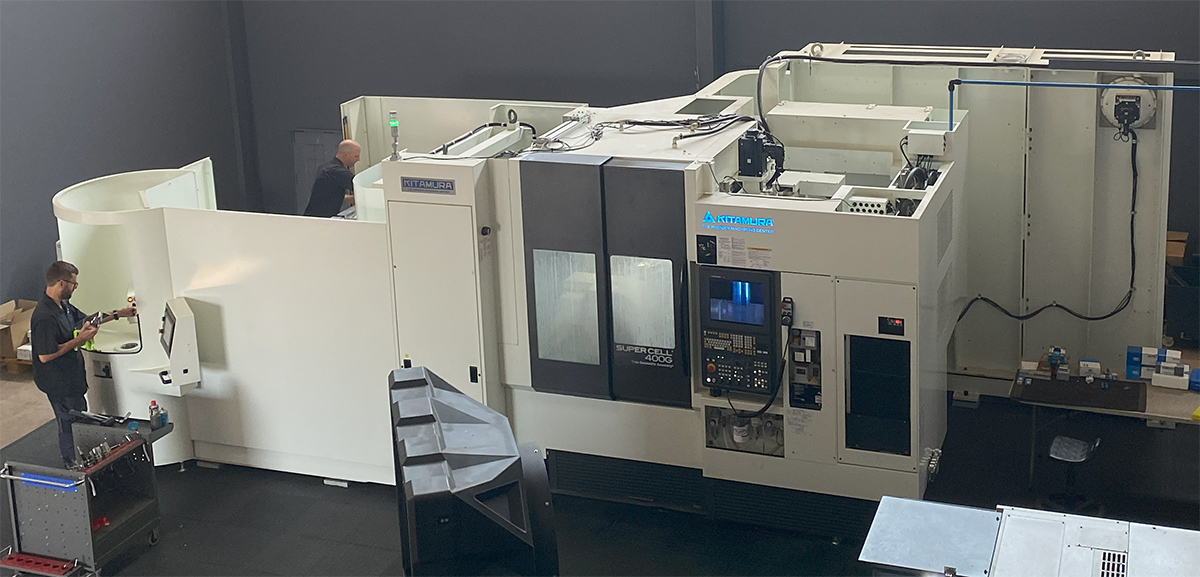
Powerbrake’s Kitamura Supercell-400G was the first of its kind to be installed on the African continent. The Supercell-400G is a 5-axis horizontal machining center and is engineered for high-volume, high-precision production environments
For the past five years, over 50% of the Dakar Rally fleet have run Powerbrake R-Line brake systems and Powerbrake can boast victories and numerous podium finishes amongst its list of achievements over the years in just this specific competition. Powerbrake’s history with the Dakar dates back to 2009 when Glyn Hall first approached the company to develop a brake system for use in the world’s most famous rally event. At the time, this required a significant investment on Powerbrake’s part but can now be considered as shaping the company’s future.
Powerbrake’s customer base require braking solutions that can perform reliably under high payloads and in extreme conditions. The company’s continued investment in local manufacturing and precision engineering has positioned it as a leading supplier in a niche but globally competitive sector.
Kitamura Supercell-400G – first of its kind on the African continent
The Supercell-400G is a 5-axis horizontal machining center and is engineered for high-volume, high-precision production environments. Designed with a focus on automation and unmanned operation, the machine integrates a built-in horizontal pallet pool system capable of handling up to 180 pallets, making it suitable for continuous production across multiple product variants.

“We are not a job shop so the integration of this technology needed to reflect that machining calipers is what this machine’s main job is.”
Though the machine’s general design is nothing new in terms of 5-axis machining, it has undergone significant technological upgrades since it was first introduced by Kitamura in the late 1980s.
Buried within the Supercell-400G is a high-speed, high-torque spindle capable of handling both ferrous and non-ferrous materials. The 5-axis configuration allows for simultaneous multi-face machining, reducing setups and improving geometric accuracy across complex components. The horizontal spindle layout also assists in efficient chip evacuation, improving cutting performance and tool life.
The machine is equipped with a tool magazine that can hold over 400 tools, depending on configuration, with tool breakage detection and automatic tool changeover to minimise downtime. Integrated probing systems handle in-process measurement and feedback for adaptive control.
Thermal stability is managed through a combination of core-cooled spindle, temperature-controlled casting, and real-time compensation algorithms. The Supercell-400G supports high-pressure coolant systems, tool life monitoring, and networked data collection, positioning it within modern smart manufacturing requirements.

“Typically, our cycle times on our calipers range between 30 to 45 minutes and that billet is reduced to 18% of the weight of the original billet by the time we have finished machining it.”
It is used extensively in automotive, aerospace, and precision component manufacturing, where high throughput and tight tolerances are critical. The machine’s automation capabilities make it suitable for lights-out production. Powerbrake optioned the machine with 40 pallets and 290 tools.
In order to fully secure the machine for manufacturing, Powerbrake undertook an extensive installation procedure that involved digging down 1.2m, backfilling with rebar and laying a 90cm concrete base for the Supercell to sit on. The spindle can rotate at 20 000rpm and you wouldn’t even know it. In anticipation of further expansion, and in order not to disrupt production within this new dedicated factory space, Powerbrake repeated the process and laid a second concrete bed for a second machine.
“We claim to manufacture the best 4×4 brake kits in the world and we do. Our X-Line kits feature direct technology transfer from our R-Line kits and that’s really where our expertise lies – we used to run a production line of various different kits for all forms of high-performance racing but in 2019 decided to make a key strategic decision to focus solely on the 4×4 and offroad market,” says Powerbrake’s owner, Clive Murphy.

Powerbrake engineers optimise tool paths for cycle time reduction without compromising surface finish or dimensional accuracy. All critical dimensions are machined to tolerances within single-digit hundredths of a millimetre
“So often people load up their 4×4 vehicle with heavy items like draw systems, fridges, fridge slides, larger tyres, rooftop tents and roof racks and all sorts of other heavy items but they don’t consider that all this extra weight reduces the braking capabilities of their original equipment (OE) 4×4 brake kits on their vehicles.”
“You add to that the cost of all of this extra equipment and really, upgrading your brake performance really doesn’t cost that much when compared to the overall expense of what you’ve added to your overland vehicle. This is safety-critical equipment we are talking about, and the OE brake kits are just not engineered for all of this extra weight. We have experienced very good customer retention over the years and this has also been part of our success. Once you’ve had one of our components or kits fitted to your vehicle, it’s hard to adjust back to where you were. Often, we find that when a repeat customer gets a new vehicle, one of the first things they do is drive straight here and get a kit fitted.”

“Our new Lang FS jaws apply the correct stamping profile for Lang’s new Makro-Grip FS (Full Serration) vises. The new jaw profile can still be used to stamp billets for all our existing (previous generation) Lang vises as well for all of the new Lang FS vises that we invested in for the new Kitamura. Typically, you’re looking at using 10mm to 15mm of your billet in the vise but with our setup we only need 3.5mm to safely grip the billet.”
“For years we knew that we wanted to get into lights-out manufacturing. It took us some time to settle on the Kitamura Supercell-400G but the Japanese engineering along with the backup support from WD Hearn Machine Tools who facilitated the purchase and installation has been phenomenal. Johan Neveling has to be the top CNC applications engineer in the country. We now typically run this machine for 24 hours a day for at least five days in a week. We wanted to have some buffer with it and we can also ramp up production to seven days a week when we need to.”
“We didn’t need to employ anyone specifically to run it and it typically only needs about an hour of human attendance in a day to keep it running unattended. It’s packed full of features that appealed to us like the fact that we could easily integrate aftermarket components to it that make it that little bit more efficient like an extra fan that supports better swarf removal and drying of a fully machined billet between changeovers.”

The Kitamura Supercell-400G integrates a built-in horizontal pallet pool system capable of handling up to 180 pallets. Powerbrake optioned theirs with 40 pallets and 290 tools
“Let’s take machining our calipers for example. We are not a job shop so the integration of this technology needed to reflect that machining calipers is what this machine’s main job is. Typically, our cycle times on our calipers range between 30 to 45 minutes and that billet is reduced to 18% of the weight of the original billet by the time we have finished machining it. In order to optimise as much use of the material from that billet as we could, we also made adjustments to our Lang stamping unit that we have been using since 2015.”
“The new Lang FS jaws apply the correct stamping profile for Lang’s new Makro-Grip FS (Full Serration) vises. The new jaw profile can still be used to stamp billets for all our existing (previous generation) Lang vises as well for all of the new Lang FS vises that we invested in for the new Kitamura. Typically, you’re looking at using 10mm to 15mm of your billet in the vise but with our setup we only need 3.5mm to safely grip the billet. Everything here is about optimisation coupled with the tightest of tolerances because of our extremely strict quality control measures. We are optimised for what we do and so is the Kitamura Supercell-400G.”

In terms of production volume, Powerbrake runs a just-in-time manufacturing model with thousands of components manufactured monthly. Setup reduction strategies and fixture standardisation allow the company to change over product lines quickly
Programmes are written in-house, and full CAM simulation is conducted before running production. Powerbrake engineers optimise tool paths for cycle time reduction without compromising surface finish or dimensional accuracy. All critical dimensions are machined to tolerances within single-digit hundredths of a millimetre. Once machined, calipers and other aluminium components are treated using a hard anodising process that enhances corrosion resistance and surface hardness.
Brake rotors are two-piece assemblies. The disc hats are machined from billet aluminium and hard anodised. The friction rings are cast from proprietary high-carbon alloys, selected for heat dissipation and wear properties. These rings are machined on specialised vertical turning centers. The company uses dedicated tooling for inner and outer profiles, with automated part probing for runout and dimensional checks. Assembly of the two-piece rotors is done using floating hardware, designed and manufactured in-house.

Powerbrake X-Line 6-piston 4×4 calipers
Powerbrake’s manufacturing process also includes extensive part marking and traceability. All components are laser-engraved with serial numbers and batch data, and a full traceability chain is maintained from raw material to final inspection – all of this data is recorded forever. The company uses a serialisation protocol that allows components to be traced back through every production stage, including CNC programme version, machine operator, tool life, and inspection report.
Quality control is integrated into every phase of manufacturing. On-machine probing systems are used for in-cycle inspection. Each machined component is measured with contact and non-contact metrology systems. Powerbrake’s inspection room is climate-controlled and houses several CMMs (coordinate measuring machines), surface finish testers, and optical comparators. The company runs SPC (statistical process control) software on live production data, and process capability indices are continuously monitored.

Powerbrake R-Line 6-piston off-road race calipers
Brake calipers undergo pressure testing after assembly. Any sign of seal leakage or deformation results in scrapping. Assembled calipers are torque tested and inspected again before packaging. Disc assemblies are checked for lateral runout and balance, with automated pass/fail logging.
Powerbrake’s testing protocols also extend to the field. The company works with motorsport teams and expedition groups to test new systems in real-world applications. Data loggers record braking temperature, pressure, and deceleration profiles. This feedback is used to inform material selection, cooling fin design, and further pad compound development research.
The company’s design and R&D division uses CAD/CAM/CAE tools to model stress, thermal deformation, and material flow. Engineers conduct finite element analysis (FEA) to identify weak points, and computational fluid dynamics (CFD) is used for airflow optimisation around the disc vanes and caliper body. New products undergo thousands of braking cycles on a dynamometer before release.

Powerbrake X-Line 4×4 big brake kit
Powerbrake also has a proprietary pad development programme. The company tests multiple friction compounds in a range of environments, from cold and wet conditions to high-speed desert rally stages. All pads are chamfered and slotted and are manufactured to fit specific caliper and rotor designs.
In terms of production volume, Powerbrake runs a just-in-time manufacturing model with thousands of components manufactured monthly. Setup reduction strategies and fixture standardisation allow the company to change over product lines quickly.
Powerbrake exports to more than 30 countries, with distribution networks covering North America, South America, Europe, Africa, the Middle East, Russia, China and Asia Pacific regions. The company also supplies brake systems to armoured vehicle manufacturers and defence contractors.
With complete in-house control, vertical integration, and an ongoing investment in machining technology, Powerbrake has built a production model that is both agile and repeatable. The Tshwane factory now employs 30 people.
For more information contact Powerbrake on TEL: +2712 803 0155 or visit https://www.powerbrake.co.za

