Some people know from an early age that being office bound and wearing a tie and carting a briefcase around is not for them. That was the case for Michael Auret, owner of Aumic Engineering and practical machinist, designer and charismatic shop floor enthusiast. Something Auret also knew though was that he always wanted to work with his hands.
After finishing school, Auret initially studied sports science but he found out early on into that career that it just wasn’t bringing him the job satisfaction that he craved. After some time travelling overseas, he returned to South Africa and got a taste of the engineering world when he visited a machine shop owned by a family friend.
It was then that he decided to pair his love of aircraft and applied himself by enrolling to Ekurhuleni West TVET College’s Kempton campus where he studied aircraft maintenance. An opportunity came along during this time for Auret to join an aerospace and military technology conglomerate. An opportunity he wasn’t going to miss.

“One thing we have been quite well-known for over the years is our roller engineering. I designed and engineered a fully sealed roller that targets the needs of the cement truck industry. We decided to call our roller the S-2 roller and I redesigned it to have bigger bearings but more importantly to be a fully sealed unit.”
“I was there for about a week before I walked across to the machine shop and saw my first CNC machine. That was when I knew what I wanted to do,” reminisces Auret. “It’s interesting because my grandfather was a blue-collar worker and he had worked on lathes his whole life. My dad saw that this life had not been an easy one for my grandfather and so he decided that he was going to be a corporate banker and that is what he did his whole life. I don’t think my parents envisioned me running a machine shop one day but I do know that they are very proud of my achievements now.”
With this background in aviation mechanics maintenance and many friends linked to the aviation industry working in aircraft maintenance and avionics, it’s fitting that Auret established his business in Jet Park, Boksburg back in 2008.
“I wasn’t really interested in the repetitive work. And I thought, okay, if I’m going to do my apprenticeship and I want to start my own business one day, that is the direction where I want my business to go. With this industry, you know, it’s always chopping and changing and I love it. There’s nothing boring, you never get the same product. And if you do repetitive work, there are always projects behind it.”
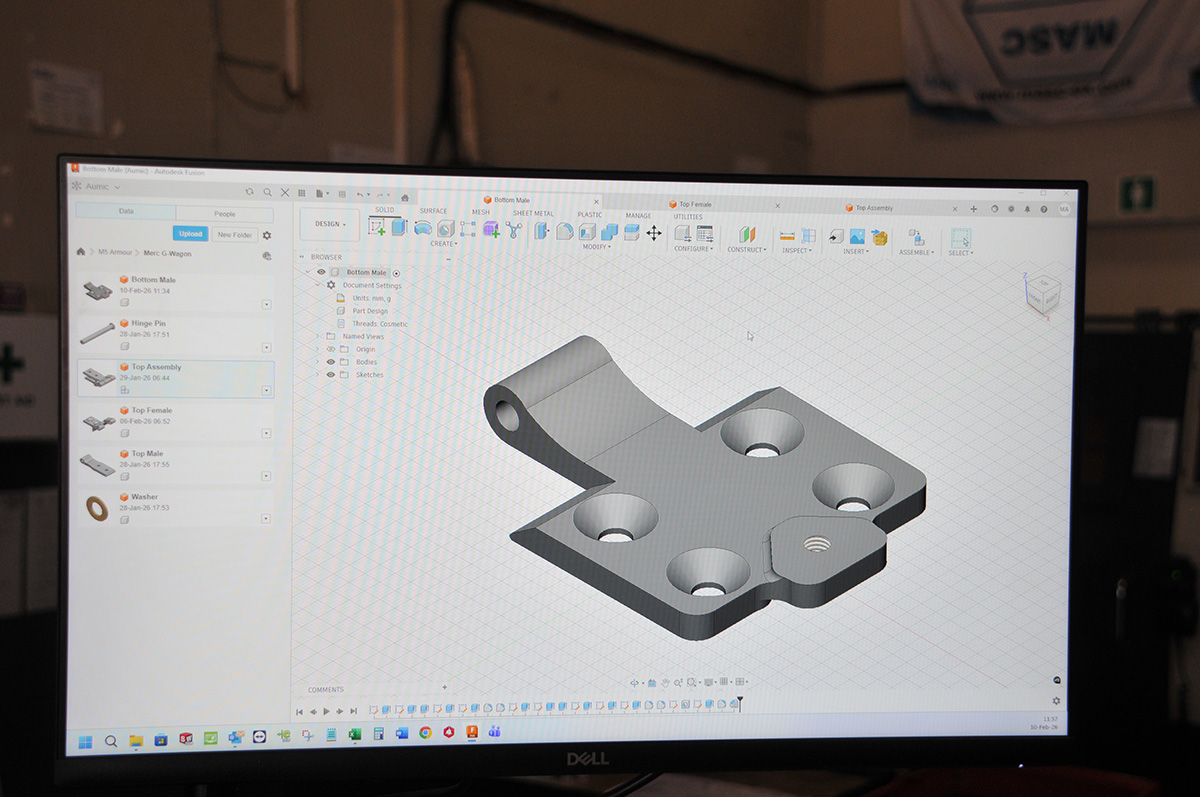
Reverse engineering and custom design work make up a fair portion of Aumic Engineering’s work. Pictured is an armour-rated door hinge designed for your top-end 4×4’s and SUV’s that Aumic Engineering designed using Fusion
“After completing my apprenticeship, I got an opportunity with another local engineering business and that’s where I really started to come into my own. It didn’t take me long to become the foreman of my team and at that stage we were running about nine CNC machines on our shop floor,” said Auret.
“After a few years, another break came when myself and a business partner got to start up a wire cutting business. We started with one machine and ended up running three that basically ran for two years 24 hours a day. It was crazy. We were very busy. Two-o’clock in the morning, every six hours, I was rotating operations. It was hard work, but it was worth it. It gave us a nice cash flow after those first two years.”
“I then decided to buy my business partner out and that’s when I started buying our first CNC machines, which is more my passion. I used to run the floor, do the marketing, do the finances and all that kind of stuff by myself, and then, of course, we started growing.”
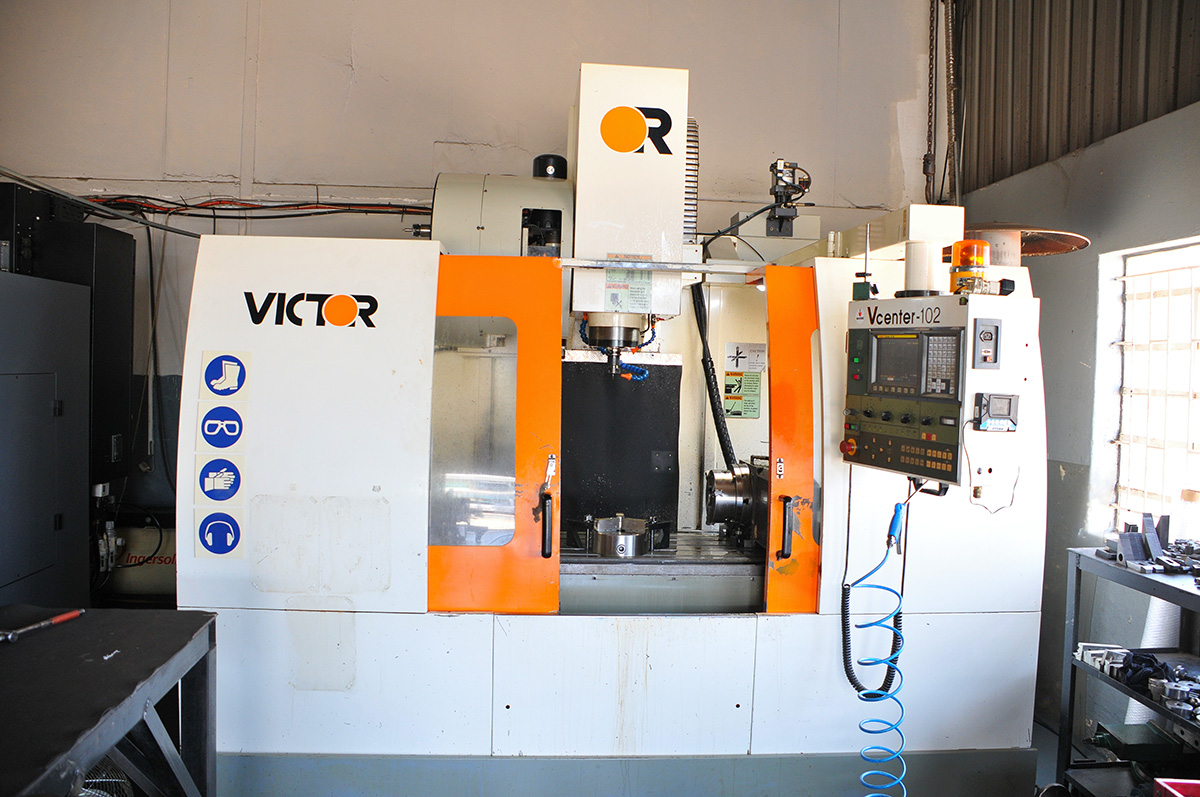
Aumic Engineering’s Victor Vcenter 102 vertical machining center is equipped with a 4th axis rotary table – the rotary table gives Aumic Engineering an ability to machine complex and intricate components
“I had actually registered the business in 2008 and we were running operations at night while I was still working for one of my previous employers but it was only really in 2010 that we started to get going. I had purchased a second-hand 4-axis milling machine and that’s how we got going in those early days.”
“Being a machinist, I needed some help with learning how to run and grow my own business so I decided that I needed to invest in a business coach. That coach worked closely with me for the next five years and he taught me so much about being an entrepreneur. I would recommend this process to anyone in business because it really helps you to think outside of the box and look at things through a different lens. With his help and guidance I was able to consistently grow my turnover and my business as a result in those early years.”

Aumic Engineering purchased a Hurco VM20i vertical machining center to help with a specific order. The Hurco VM20i is a 3-axis vertical machining center with X, Y and Z travels of 1 016mm x 508mm x 508mm, a 12 000rpm spindle and a 24 tool automatic tool changer. It was supplied by TH Machine Tools. Aumic Engineering also have a smaller version of that machine – a Hurco VM10i. It’s a compact 3-axis vertical machining center designed for efficiency with a 1.8m2 footprint
“That was until Covid came along. We survived that though and it also taught me to look beyond some of the components that we had been manufacturing and to look for new markets and new customers. Now a sizeable portion of our business is focussed on dust ignition-proof equipment and flameproof components for the mining industry. We hold MASC certification (Mining and Surface Certification) which means we hold certificates for equipment and components used in areas with explosive atmospheres.”
“We have also been accredited with ISO:9001 and this has opened up business opportunities for us internationally. It was also an eye-opening moment in terms of what it takes to obtain this kind of certification for your business. It also reminded me of my ethics as a business person in that I am never going to cut corners. If something doesn’t feel right for me in terms of how contracts are being put in place or similar, I have learned to walk away. I am a guy that operates straight down the line,” says Auret.

Aumic Engineering hold MASC certification (Mining and Surface Certification) which means that they hold certificates for equipment and components used in areas with explosive atmospheres
“Recently we have also moved away from some other well-known software packages to one that currently suits our needs and operations better – Fusion. I will have had a guy with me for about a year soon on the design side and once he showed me how easy it was to use Fusion it was a no brainer for us. I really like the 3D rendering it offers us for some of the components we are engineering like the armour-rated door hinges for your top-end 4×4’s and SUV’s, and of course, you can’t beat its affordability.”
“An area we have focussed on and built a bit of a reputation in is reverse engineering. If a customer has a problem with a component – say it’s not the correct sizing or he just wants a better designed component, that’s when we will step in. We will do the necessary in terms of scanning and redesigning and redrawing the component where needed and then we will manufacture a sample for them. From there we take things to full scale production. These components can range from hinges to massive hydraulic cylinders. It’s obviously not as simple as that though and a lot goes into the process such as calculating material strengths and taking into account what sort of other components the new component must work together with. But this is where we work closely with the customer to make sure that the end component is exactly to their needs – precision engineered.”

A sizeable portion of Aumic Engineering’s business is focussed on dust ignition-proof equipment and flameproof components for the mining industry for which Aumic hold MASC certification
“Simply though, Aumic Engineering offers a full turnkey precision engineering service. We have full CNC capabilities that includes CNC turning, CNC milling, drilling, taping, chamfering, splining, slotting, sawing, polishing, boring, threading, profile milling, 4th axis milling and pressing of bearings. Aumic will also handle all the assembly of components,” explained Auret.
“We work with a range of materials from your stainless steels to titanium, aluminium as well as various polymers too,” says Auret.
“One thing we have been quite well-known for over the years is our roller engineering. It is not as much a part of our business as it was a number of years ago, but I basically designed and engineered a fully sealed roller that targets the needs of the cement truck industry. What had been available at the time in terms of rollers were just inferior in respect of their design quality for their specific application.”
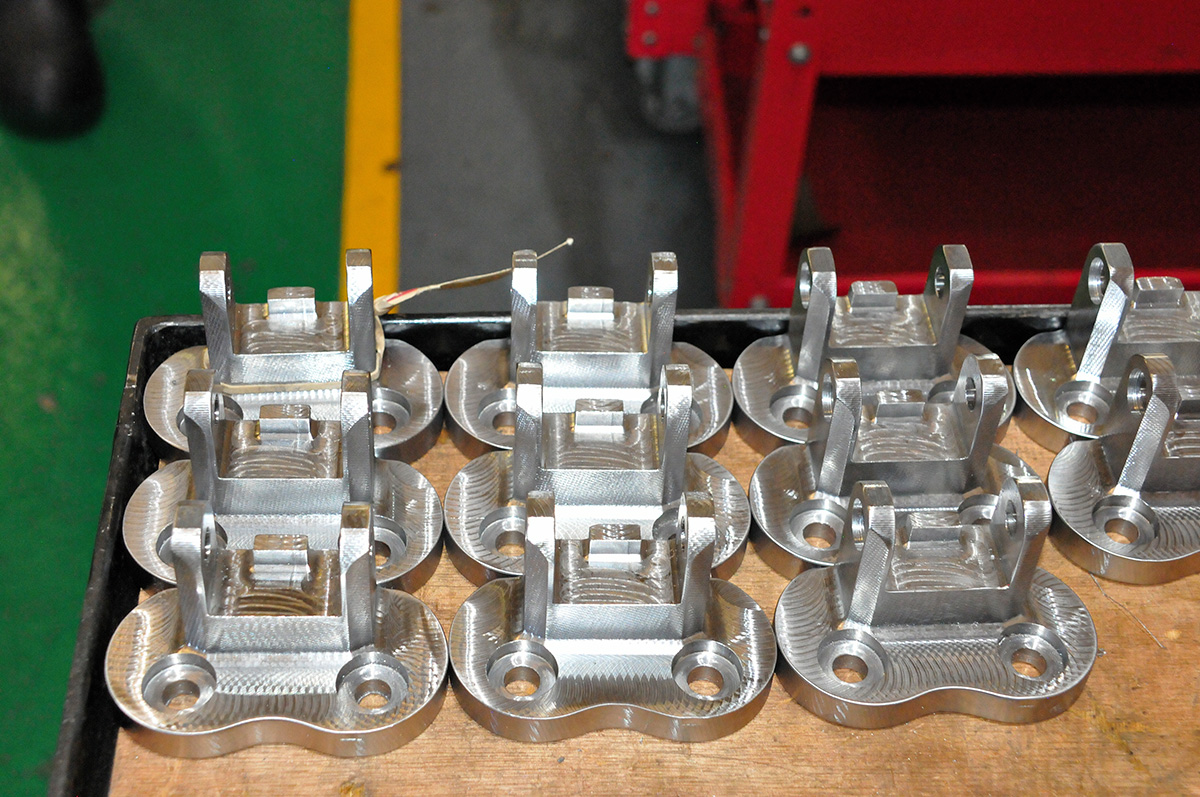
Aumic Engineering manufacture a range of different precision engineered components
“We decided to call our roller the S-2 roller and I redesigned it to have bigger bearings but more importantly to be a fully sealed unit. With it being a fully sealed unit, that ensured that no cement dust would enter the unit causing premature wear from abrasions inside the bearings. Although these rollers are primarily wear components, I wanted to redesign them in such a way that they would last for more than a few months before they needed replacing. We are now able to offer a full range of different sized rollers and some of our rollers are still operating in the filed some four to five years later.”
Another speciality component that Aumic Engineering manufactures for the mining sector are various end nuts. These are safety critical components that have to be designed and engineered to certain lengths and threads and from high tensile materials. These components also need to adhere to very specific safety requirements that ensure that the units that they get fastened to are flameproof.
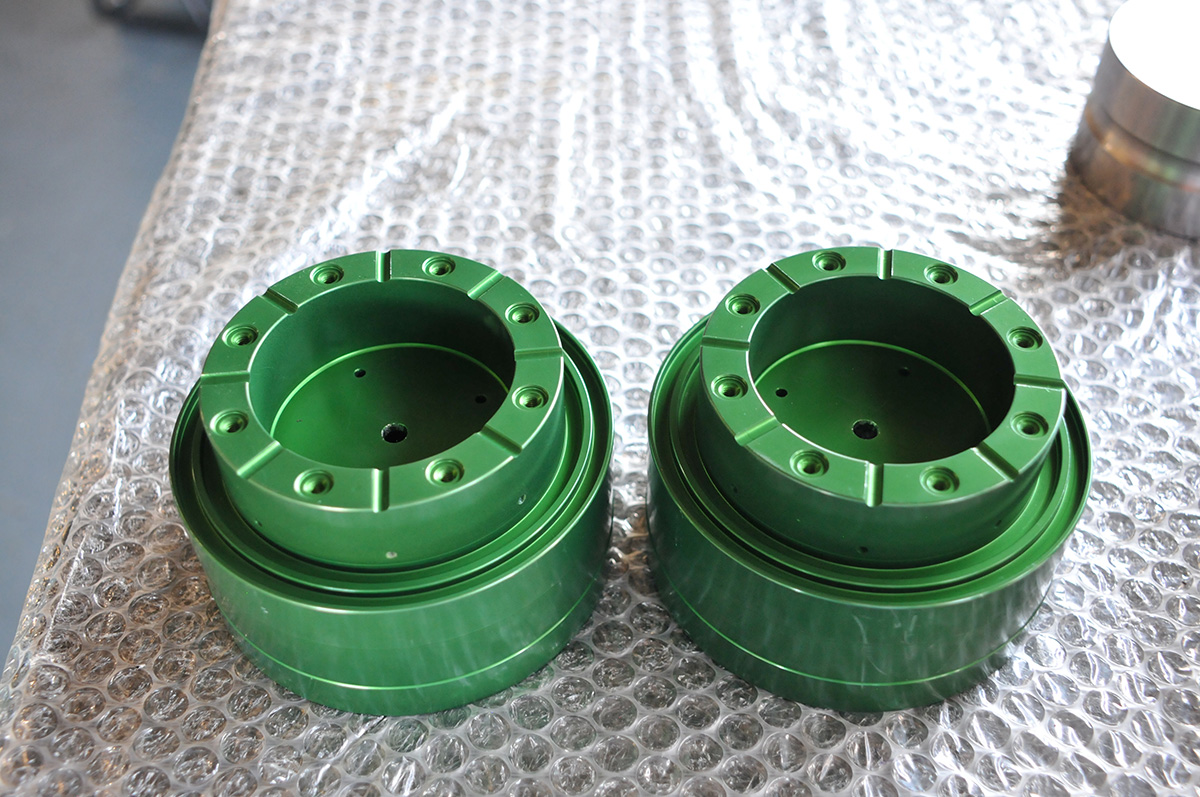
Anodised aluminium components ready for delivery
“We have never stuck to one brand of tooling and have always experimented with what is out there. To give you an idea, we were machining one bracket and it would take – just the roughing cycles – 27 minutes. A new tool arrived two weeks ago for us to test out and we got the process down to 14 and a half minutes. This next order we will run will be for that component is going to be for over 500 units so that’s a lot of time saved. Tooling is the mathemagics of your business as I like to call it.”
“We have worked on some really interesting projects over the years. As I mentioned, the cement roller project was really good for us and we got a lot of traction out of that project. We have recently actually been in discussions with an old contact of mine and who knows, there might be further scope for that project in the future.”

“An area we have focussed on and built a bit of a reputation in is reverse engineering. If a customer has a problem with a component – say it’s not the correct sizing or he just wants a better designed component, that’s when we will step in.”
“Another interesting project that we were able to redesign, prototype and bring to the manufacturing stage was for a component called an armature that forms part of a slurry pump. The company had been getting this component manufactured where it had fins that ran down part of the side of the component and at 8 000rpm when these components were turning in the pump – helping to remove sludge – they would just break off.”
“So we redesigned the component and machined it as a whole component out of solid billet using our Victor Vcenter 102 vertical machining center with its 4th axis rotary table after the component had been through the lathe for initial material removal and they are extremely happy with how it changed their operations. Previously the fins that you see now fully machined as one part of the one component had been separately machined and welded onto the core part of the component. Our component is made out of 304L stainless steel so it offers excellent corrosion resistance and part of the redesign from our side actually involved changing the angle that the fins faced. Previously they were in a straight line whereas we have redesigned them to be at an angle meaning overall the component functions a lot better than it did previously.”

“Another interesting project that we were able to redesign, prototype and bring to the manufacturing stage was for a component called an armature that forms part of a slurry pump. The company had been getting this component manufactured where it had fins that ran down part of the side of the component and at 8 000rpm when these components were turning in the pump – helping to remove sludge – they would just break off. So we redesigned the component and machined it as a whole component out of solid billet.”
“Our Victor Vcenter 102 VMC has X, Y and Z travels of 1 020mm x 520mm x 560mm and a table size of 1 100mm x 510mm. Its rotary table though really gives us that ability to machine complex and intricate components.”
“One of our best success stories though has to be a polycarbonate casing that houses digital displays and that could be mounted onto the dashboard of earth moving equipment. We went through a few design revisions with the customer and eventually settled on one that was IP63 rated and that the customer loved. He ended up placing such a good order with us that we ended up purchasing our Hurco VM20i vertical machining center just to help with that specific order. The Hurco VM20i is a 3-axis vertical machining center with X, Y and Z travels of 1 016mm x 508mm x 508mm, a 12 000rpm spindle and a 24 tool automatic tool changer. It was supplied by TH Machine Tools.”
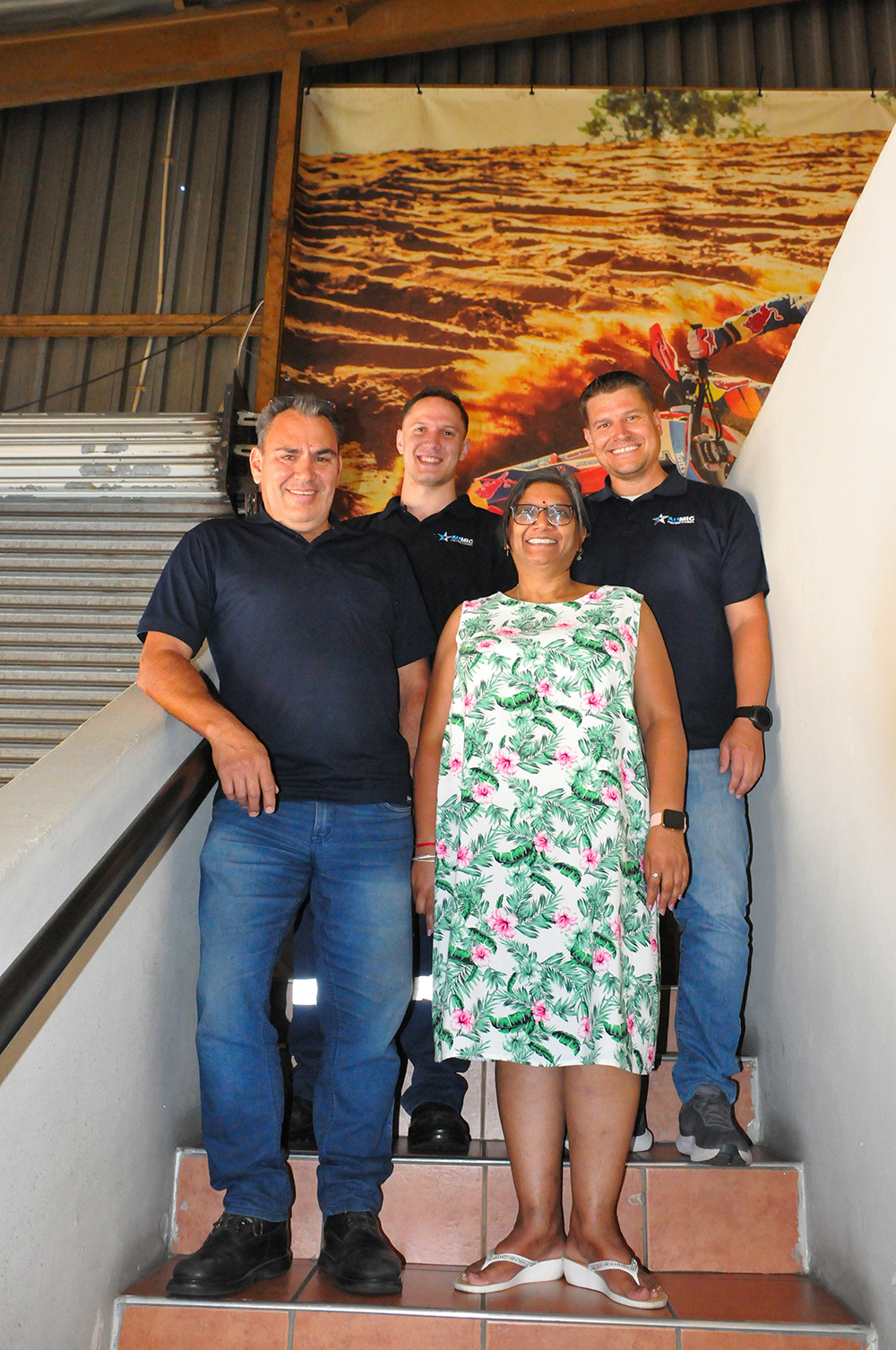
Some of Aumic Engineering’s staff. From left to right, Sean Delport, Johann Albasini, Sharmaine Mari, and owner Michael Auret
“We also have a smaller version of that machine – our Hurco VM10i. It is a compact 3-axis vertical machining center designed for efficiency with a 1.8m2 footprint. It has X, Y and Z travels of 660mm x 406mm x 508mm, a 10 000rpm spindle and a 24 tool automatic tool changer. Both machines feature BT-40 tooling.”
“Aumic Engineering currently have five CNC machines on the shop floor that include three mills and two lathes.”

Aumic Engieering’s shop floor is compact but efficient allowing component production to flow seamlessly
Currently Aumic Engineering employ 10 people and one philosophy Auret said has helped immensely with staff retention and staff investment in the business over the years has been to include them wherever possible in the business. It creates a sense of camaraderie and creates a culture where employees enjoy their job and what they do. “When there is training, we all go together. You just see immediate benefits when it comes to efficiency and quality of components being manufactured, and when the staff know that their work might go on display on social media or elsewhere you just see a sense of pride,” concluded Auret.
For further details contact Aumic Engineering on TEL: +27 72 441 3366 or visit https://www.aumic.co.za

